

S
Suizident
Student
- Aug 7, 2025
- 113
Hi,
like so many others, I have trouble finding the sweet spot. Like most people, I can only manage to feel pressure in my head and eyes. Most people on the forum think the reason for this is that the jugular vein is being hit instead of the sweet spot.
To be honest, I personally don't find most of the anatomical images posted here in the forum to help locate the sweet spot very helpful. Most of the time, they only show the carotid arteries, but not the jugular veins as well. So I looked for an image that shows the jugular veins in addition to the carotid arteries. This was to make it easier for me to locate the carotid arteries in relation to the jugular veins. Because: If I can create a sensation of pressure in the head, then—in theory—I've at least managed to find the jugular veins. The idea was to use the location of the jugular veins as a starting point and, with the help of the anatomical drawing, work my way toward the carotid arteries.
Here is the image I found; both the carotid artery (red) and the jugular vein (blue) are shown:
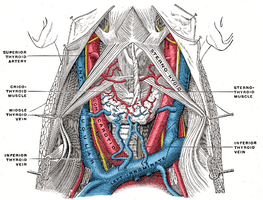
With the help of AI, I tried to analyze the image from an anatomical perspective. If anyone thinks there's a flaw in my reasoning, please let me know:
1.
The carotid artery lies more ventrally than the jugular vein, meaning it is closer to the skin on the front of the neck than the vein. Therefore, it should actually be easier to locate the artery by pressing from the outside than the vein (at least that makes sense to me).
But this raises the question: why do most people hit the vein instead of the artery? If the artery is closer to the skin of the neck than the vein, it should be easier to hit the artery than the vein. Does anyone have any idea why this is the case?
2.
The artery lies less laterally to the larynx than the vein. In other words, the right carotid artery lies to the left of the right jugular vein, and the left carotid artery lies to the right of the left jugular vein.
Accordingly, if you notice that pressure builds up in your head when pressing, you should move the pressure point slightly closer toward the larynx (but not so far that you press on the larynx itself) to ensure that you press on the artery instead of the vein (i.e., less laterally to the larynx). This applies if (!) the assumption that the sensation of pressure in the head is caused by pressure on the vein is correct.
I tried option 2 (after I managed to create a sensation of pressure in my head) by moving my fingers further laterally (i.e., shifting the pressure point slightly away from the larynx). According to the theory, I should have hit the artery then. But I didn't—at least, I wasn't able to produce the symptoms described by those who've succeeded, which are supposed to result from pressing the sweet spot: tunnel vision, fading out, and euphoria.
I tried to stay close to the throat to hit the artery and not the vein. When I noticed pressure building in my head, I moved more toward the larynx (but without pressing on the throat).
Possible causes:
a. The technique I used was to form a U-shape with my index finger and thumb, then press my thumb against the pulse to the right of the larynx and my index and ring fingers against the pulse to the left of the throat.
b According to AI, the carotid artery has a diameter/width of 4–6 mm. I have fairly narrow fingertips, and I really only pressed with my fingertips (i.e., not with the entire pad of my finger) in a dorsal direction (i.e., from the front toward the back). Perhaps I was unable to compress it due to the width of the artery, or did it possibly slip sideways under the pressure of my fingertips?
If that is the reason, however, the question arises as to why most people apparently succeed in compressing the vein, since it is the same width as the artery.
Another reason why it's so hard to squeeze the vein might be:
I'm excited to hear any good ideas anyone has—especially from those of you who've already found your sweet spot and maybe know a sort of "algorithm" for how best to pinpoint it (most of the explanations I've found on the forum are pretty general, though maybe I've missed something)—or from anyone else who has a good idea.
Explanation of the terms "ventral" and "lateral":
ventral: closer to the front of the neck
lateral: farther from the larynx and closer to the side of the neck
---
Let's all work together to find our sweet spots!
Many thanks and best regards.
Suizident
like so many others, I have trouble finding the sweet spot. Like most people, I can only manage to feel pressure in my head and eyes. Most people on the forum think the reason for this is that the jugular vein is being hit instead of the sweet spot.
To be honest, I personally don't find most of the anatomical images posted here in the forum to help locate the sweet spot very helpful. Most of the time, they only show the carotid arteries, but not the jugular veins as well. So I looked for an image that shows the jugular veins in addition to the carotid arteries. This was to make it easier for me to locate the carotid arteries in relation to the jugular veins. Because: If I can create a sensation of pressure in the head, then—in theory—I've at least managed to find the jugular veins. The idea was to use the location of the jugular veins as a starting point and, with the help of the anatomical drawing, work my way toward the carotid arteries.
Here is the image I found; both the carotid artery (red) and the jugular vein (blue) are shown:
With the help of AI, I tried to analyze the image from an anatomical perspective. If anyone thinks there's a flaw in my reasoning, please let me know:
1.
The carotid artery lies more ventrally than the jugular vein, meaning it is closer to the skin on the front of the neck than the vein. Therefore, it should actually be easier to locate the artery by pressing from the outside than the vein (at least that makes sense to me).
But this raises the question: why do most people hit the vein instead of the artery? If the artery is closer to the skin of the neck than the vein, it should be easier to hit the artery than the vein. Does anyone have any idea why this is the case?
2.
The artery lies less laterally to the larynx than the vein. In other words, the right carotid artery lies to the left of the right jugular vein, and the left carotid artery lies to the right of the left jugular vein.
Accordingly, if you notice that pressure builds up in your head when pressing, you should move the pressure point slightly closer toward the larynx (but not so far that you press on the larynx itself) to ensure that you press on the artery instead of the vein (i.e., less laterally to the larynx). This applies if (!) the assumption that the sensation of pressure in the head is caused by pressure on the vein is correct.
I tried option 2 (after I managed to create a sensation of pressure in my head) by moving my fingers further laterally (i.e., shifting the pressure point slightly away from the larynx). According to the theory, I should have hit the artery then. But I didn't—at least, I wasn't able to produce the symptoms described by those who've succeeded, which are supposed to result from pressing the sweet spot: tunnel vision, fading out, and euphoria.
I tried to stay close to the throat to hit the artery and not the vein. When I noticed pressure building in my head, I moved more toward the larynx (but without pressing on the throat).
Possible causes:
a. The technique I used was to form a U-shape with my index finger and thumb, then press my thumb against the pulse to the right of the larynx and my index and ring fingers against the pulse to the left of the throat.
b According to AI, the carotid artery has a diameter/width of 4–6 mm. I have fairly narrow fingertips, and I really only pressed with my fingertips (i.e., not with the entire pad of my finger) in a dorsal direction (i.e., from the front toward the back). Perhaps I was unable to compress it due to the width of the artery, or did it possibly slip sideways under the pressure of my fingertips?
If that is the reason, however, the question arises as to why most people apparently succeed in compressing the vein, since it is the same width as the artery.
Another reason why it's so hard to squeeze the vein might be:
I'm excited to hear any good ideas anyone has—especially from those of you who've already found your sweet spot and maybe know a sort of "algorithm" for how best to pinpoint it (most of the explanations I've found on the forum are pretty general, though maybe I've missed something)—or from anyone else who has a good idea.
Explanation of the terms "ventral" and "lateral":
ventral: closer to the front of the neck
lateral: farther from the larynx and closer to the side of the neck
---
Let's all work together to find our sweet spots!
Many thanks and best regards.
Suizident
Last edited:


