• Hey Guest,

    We wanted to share a quick update with the community.

    Our public expense ledger is now live, allowing anyone to see how donations are used to support the ongoing operation of the site.

    👉 View the ledger here

    Over the past year, increased regulatory pressure in multiple regions like UK OFCOM and Australia's eSafety has led to higher operational costs, including infrastructure, security, and the need to work with more specialized service providers to keep the site online and stable.

    If you value the community and would like to help support its continued operation, donations are greatly appreciated. If you wish to donate via Bank Transfer or other options, please open a ticket.

    Donate via cryptocurrency:

    Bitcoin (BTC):
    Ethereum (ETH):
    Monero (XMR):
JesiBel

JesiBel

protoTYPE:cclxxv
Dec 5, 2024
1,064
should the length of the rope be short enough that I'm still not touching the ground if the dumbbell starts to lift up? sorry I'm just having a. little bit of trouble understanding how a 2kg dumbbell is supposed to hold up my weight even if it doesn't break
The dumbbell serves as an anchor on the other side of the door; it is not a counterweight.

I had already posted this photo in another thread, but it serves as a graphic example:

Hidden content
You need -1 more posts to view this content

It's important that the door doesn't open under any circumstances, or you'll fall and your attempt will be unsuccessful/interrupted. You'll need to lock the door.
 
  • Like
Reactions: Krokodile, AreWeWinning and happy2die
dreamgarden

dreamgarden

-
Oct 30, 2025
27
The dumbbell serves as an anchor on the other side of the door; it is not a counterweight.

I had already posted this photo in another thread, but it serves as a graphic example:

[Hidden content]

It's important that the door doesn't open under any circumstances, or you'll fall and your attempt will be unsuccessful/interrupted. You'll need to lock the door.
if it's not too much trouble, could you elaborate on this? i'm probably being stupid but i can't seem to wrap my mind around this, coupled with the fact that i am a lost cause when it comes to physics and the like. my main concern would be my weight on the door being too much and the door coming loose off the hinges and ruining my attempt - especially if the door and its hinges are very old. or perhaps i'm being needlessly paranoid?
 
I

ifihadnever

Student
Sep 20, 2025
172
I feel you. I dont understand this at all. I can grasp the purpose of a very low weight dumbell.

But ive always measured my doors and they are high anyway, given if I could work out this dumbell thing, it wouldn't result in full suspension for me. So, I gave up trying to understand it.
 
AreWeWinning

AreWeWinning

·
Nov 1, 2021
562
if it's not too much trouble, could you elaborate on this? i'm probably being stupid but i can't seem to wrap my mind around this, coupled with the fact that i am a lost cause when it comes to physics and the like. my main concern would be my weight on the door being too much and the door coming loose off the hinges and ruining my attempt - especially if the door and its hinges are very old. or perhaps i'm being needlessly paranoid?
I feel you. I dont understand this at all. I can grasp the purpose of a very low weight dumbell.

But ive always measured my doors and they are high anyway, given if I could work out this dumbell thing, it wouldn't result in full suspension for me. So, I gave up trying to understand it.

The physics of it is that the dumbbell can't fit through the gap between the door and the doorframe. If you tie a rope to a dumbbell (or any other object that's too large to fit through the gap), you can pull on the rope, and it'll hold. The reason it'll hold is that the rope is tied to an object that can't fit through the gap.

When you use this as a setup, the rope and the door will mostly be pulled downward. When a door is closed and it's pulled downward, the hinges can't really come loose. This is because the door is also supported by the doorframe on both sides.

You need to be able to close the door securely in order to use it. If the door can't be closed and locked, that's risky, and you shouldn't use it for this setup.

If the door or its hinges are very old and in bad condition, then you shouldn't use this setup either.

Instead of just thinking about it, I suggest you try it. You'd see it in practice, and perhaps get a better understanding of how and why it works.

Was this helpful, or is there anything you still don't understand?
 
Last edited:
  • Like
Reactions: JesiBel and ifihadnever
I

ifihadnever

Student
Sep 20, 2025
172
The physics of it is that the dumbbell can't fit through the gap between the door and the doorframe. If you tie a rope to a dumbbell (or any other object that's too large to fit through the gap), you can pull on the rope, and it'll hold. The reason it'll hold is that the rope is tied to an object that can't fit through the gap.

When you use this as a setup, the rope and the door will mostly be pulled downward. When a door is closed and it's pulled downward, the hinges can't really come loose. This is because the door is also supported by the doorframe on both sides.

You need to be able to close the door securely in order to use it. If the door can't be closed and locked, that's risky, and you shouldn't use it for this setup.

If the door or its hinges are very old and in bad condition, then you shouldn't use this setup either.

Instead of just thinking about it, I suggest you try it. You'd see it in practice, and perhaps get a better understanding of how and why it works.

Was this helpful, or is there anything you still don't understand?
Ah that makes perfect sense thank you! Unfortunately my doors arent high enough & would result in a partial hanging as opposed to a FSH (which im hoping for) but helpful to now understand the method behind the dumbells. Thank you for explaining!
 
  • Like
Reactions: AreWeWinning
JesiBel

JesiBel

protoTYPE:cclxxv
Dec 5, 2024
1,064
if it's not too much trouble, could you elaborate on this? i'm probably being stupid but i can't seem to wrap my mind around this, coupled with the fact that i am a lost cause when it comes to physics and the like. my main concern would be my weight on the door being too much and the door coming loose off the hinges and ruining my attempt - especially if the door and its hinges are very old. or perhaps i'm being needlessly paranoid?
The anchor object* serves as a safety measure to prevent the rope from slipping to the other side of the door and causing you to fall.

The body will be suspended on the other side of the door, adding weight; if the rope is loose without a stop (anchor object), it could slip.

(* dumbbell, bottle, rolled-up towels, any object that you can tie securely and that won't break will work)

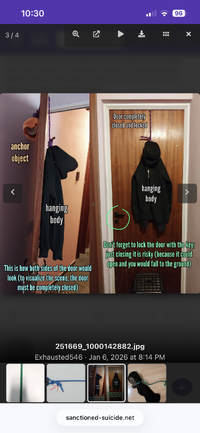
Perhaps this photo is a little more explicit and helps to understand Evelyn's idea:

Hidden content
You need -1 more posts to view this content
 
  • Informative
  • Like
Reactions: dreamgarden, AreWeWinning, BlueberryDeer and 1 other person
Worndown

Worndown

Angelic
Mar 21, 2019
4,087
Nice pictures.
If you made the rope from you to the dumbell very short and stood on a taller chair, would that work for you?
Start much higher.
 
  • Like
Reactions: JesiBel
M

metfan647

Student
Jun 12, 2025
151
I'm not 100% getting it. There is a very heavy fire door in my office building (very few colleagues and I can sneak in at night). I suspect the door would close with the rope hanging over. What purpose would the anchor then serve?
 
Gustav Hartmann

Gustav Hartmann

Enlightened
Aug 28, 2021
1,306
The anchor object* serves as a safety measure to prevent the rope from slipping to the other side of the door and causing you to fall.

The body will be suspended on the other side of the door, adding weight; if the rope is loose without a stop (anchor object), it could slip.

(* dumbbell, bottle, rolled-up towels, any object that you can tie securely and that won't break will work)

Perhaps this photo is a little more explicit and helps to understand Evelyn's idea:

[Hidden content]
The "body" is hanging on the "right" side of the door. The lever between door wing and the center of gravity of the body is "closing" the door. If I would be forced to use this set up (thanks god I am not) I would use a longer rope, etwine it around the door wing and position the "anchor" at the bottom of the door on the side of the hanging body. This way it would fail safe even if both hinges breake.
As ropes would not fit through the gaps of modern doors, I would use lashing straps instead of a rope.
 
JesiBel

JesiBel

protoTYPE:cclxxv
Dec 5, 2024
1,064
The "body" is hanging on the "right" side of the door. The lever between door wing and the center of gravity of the body is "closing" the door. If I would be forced to use this set up (thanks god I am not) I would use a longer rope, etwine it around the door wing and position the "anchor" at the bottom of the door on the side of the hanging body. This way it would fail safe even if both hinges breake.
As ropes would not fit through the gaps of modern doors, I would use lashing straps instead of a rope.
I posted that setup with a photo earlier in this thread. I like that idea better.

But OP was talking about Evelyn's setup idea.

Come on, man, how do you think you could break the door hinges even when the door is closed and locked? Unless your house is made of paper. Metal frames embedded in a concrete wall with a thick wooden door with three hinges. Please..

Any setup should always be tested beforehand. Not all houses are the same. With a little force, I can close and lock the door with the key even with the rope passing over the top of the door.

The door stays closed because it's locked with the key; I don't know what the body has to do with it (why did you mention it?)
 
  • Like
Reactions: AreWeWinning
Gustav Hartmann

Gustav Hartmann

Enlightened
Aug 28, 2021
1,306
wo I posted that setup with a photo earlier in this thread. I like that idea better.

But OP was talking about Evelyn's setup idea.

Come on, man, how do you think you could break the door hinges even when the door is closed and locked? Unless your house is made of paper. Metal frames embedded in a concrete wall with a thick wooden door with three hinges. Please..

Any setup should always be tested beforehand. Not all houses are the same. With a little force, I can close and lock the door with the key even with the rope passing over the top of the door.

The door stays closed because it's locked with the key; I don't know what the body has to do with it (why did you mention it?)
Imagine, you only have a door wing, no doorframe, only two helpers. (not a real scenario, just to make clear what I mean). If the anchor is on the ground on your side of the door, you can hang from this doorwing, but the door would tilt in your direction and you will land on the ground buried under your door. Therefore you need the two helpers who have to support the doorwing on top, on your side. Of course the doorframe undertakes the task of the two helpers. And you are on the "right" side if this task is not taken by the hinges and the door latch, which are much weaker than the door frame.
The hinges are the weakest points, no matter how stable your walls and the doorframe is, and not all of them are designed to carry a persons weight.
You are right, it´s essential, that the door is closed and locked, because the doorframe supports the door wing, but this is only necessary if the hinges are broken.
 
Last edited:
JesiBel

JesiBel

protoTYPE:cclxxv
Dec 5, 2024
1,064
Imagine, you only have a door wing, no doorframe, only two helpers. (not a real scenario, just to make clear what I mean). If the anchor is on the ground on your side of the door, you can hang from this doorwing, but the door would tilt in your direction and you will land on the ground buried under your door. Therefore you need the two helpers who have to support the doorwing on top, on your side. Of course the doorframe undertakes the task of the two helpers. And you are on the "right" side if this task is not taken by the hinges and the door latch, which are much weaker than the door frame.
The hinges are the weakest points, no matter how stable your walls and the doorframe is, and not all of them are designed to carry a persons weight.
You are right, it´s essential, that the door is closed and locked, because the doorframe supports the door wing, but this is only necessary if the hinges are broken.
Personally, I wouldn't consider using a door without a frame and without a lock or latch. Even less so if the hinges are in bad condition.

It's also worth clarifying the materials everything is made of. Always test them to make sure they're strong.

For the door to be secure, you must have both sides of the door firm, with the lock (or latch) and the hinges, one on each side. And the frame that holds everything together.

You can even hit the door with your body force to try open it and check if the lock is working properly and the entire setup/door is still in place and ok.

I'm not 100% getting it. There is a very heavy fire door in my office building (very few colleagues and I can sneak in at night). I suspect the door would close with the rope hanging over. What purpose would the anchor then serve?
The same function as a ship's anchor: to act as a stop.

If the rope were without any object tied to the other side of the door, it could slip; your body is adding weight while hanging, and something must "stop" it so that it doesn't fall.

If a ship were to throw its chain into the water without an anchor, it would not be useful for "stopping and remaining steady in one place."

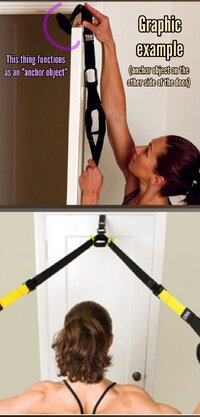
This photo with an exercise band perhaps better explains the function of the "anchor object":


You can mimic the exercise with your rope + an anchor object tied to understand how it works.
Nice pictures.
If you made the rope from you to the dumbell very short and stood on a taller chair, would that work for you?
Start much higher.
Yes, for tall people it would be better if the ligature were as high up as possible on the door.

Sometimes I forget that not everyone is short like me lol

(I wanted to show in the photo how everything looked from both sides of the door)
 
Last edited:
  • Like
Reactions: metfan647 and AreWeWinning
dreamgarden

dreamgarden

-
Oct 30, 2025
27
The physics of it is that the dumbbell can't fit through the gap between the door and the doorframe. If you tie a rope to a dumbbell (or any other object that's too large to fit through the gap), you can pull on the rope, and it'll hold. The reason it'll hold is that the rope is tied to an object that can't fit through the gap.

When you use this as a setup, the rope and the door will mostly be pulled downward. When a door is closed and it's pulled downward, the hinges can't really come loose. This is because the door is also supported by the doorframe on both sides.

You need to be able to close the door securely in order to use it. If the door can't be closed and locked, that's risky, and you shouldn't use it for this setup.

If the door or its hinges are very old and in bad condition, then you shouldn't use this setup either.

Instead of just thinking about it, I suggest you try it. You'd see it in practice, and perhaps get a better understanding of how and why it works.

Was this helpful, or is there anything you still don't understand?
yes, this makes sense to me now, thanks a lot!

do you know how i can check if my door is old? i think i'll just replace the hinges since they're creaking, but i'm not so sure what to do about the door itself.

edit: never mind actually. off first glance alone, my door is definitely not sturdy enough. i'll try finding another anchor point.
 
Last edited:
  • Hugs
  • Like
Reactions: Worndown and AreWeWinning
M

Morris1211

Student
Nov 29, 2025
133
I posted that setup with a photo earlier in this thread. I like that idea better.

But OP was talking about Evelyn's setup idea.

Come on, man, how do you think you could break the door hinges even when the door is closed and locked? Unless your house is made of paper. Metal frames embedded in a concrete wall with a thick wooden door with three hinges. Please..

Any setup should always be tested beforehand. Not all houses are the same. With a little force, I can close and lock the door with the key even with the rope passing over the top of the door.

The door stays closed because it's locked with the key; I don't know what the body has to do with it (why did you mention it?)
Does having the rope pinched between the door make it more likely it could snap under your body weight?
 
JesiBel

JesiBel

protoTYPE:cclxxv
Dec 5, 2024
1,064
Does having the rope pinched between the door make it more likely it could snap under your body weight?
I doubt it can be cut by friction. It's not a "sharp" surface. Take a piece of rope and try to cut it with the edges of the door using friction, and you'll see it's almost impossible.

In any case, in this scenario, the rope will be flattened and stuck between the door and the frame.
And the anchor object can be placed on either side, depending on your preference, as discussed earlier. You can place it above - on the opposite side of the door (as Evelyn suggests), or below - on the same side as your body (as I suggested).

You must ensure that the WLL (Working Load Limit) of your rope is higher than your weight, and always test the entire setup.

I suggest reading this entire thread, as the information, advice and photos are scattered across several posts.
 
Last edited:
  • Informative
Reactions: AreWeWinning
M

Morris1211

Student
Nov 29, 2025
133
I doubt it can be cut by friction. It's not a "sharp" surface. Take a piece of rope and try to cut it with the edges of the door using friction, and you'll see it's almost impossible.

In any case, in this scenario, the rope will be flattened and stuck between the door and the frame.
And the anchor object can be placed on either side, depending on your preference, as discussed earlier. You can place it above - on the opposite side of the door (as Evelyn suggests), or below - on the same side as your body (as I suggested).

You must ensure that the WLL (Working Load Limit) of your rope is higher than your weight, and always test the entire setup.

I suggest reading this entire thread, as the information, advice and photos are scattered across several posts.
Do you have an illustration of how you'd put the anchor point on the same side of the door as your body? I've seen this one.
 

Attachments

  • IMG_1295.png
    IMG_1295.png
    5.3 MB · Views: 0
Worndown

Worndown

Angelic
Mar 21, 2019
4,087
Will the door close with a rope over the top?
 
JesiBel

JesiBel

protoTYPE:cclxxv
Dec 5, 2024
1,064
More graphic material

(Warning: explicit content / NSFW)

• Successful attempt


Hidden content
You need -1 more posts to view this content
(video)

Hidden content
You need -1 more posts to view this content
(photos + news)

• Accidental death (autoerotic hanging)

Hidden content
You need -1 more posts to view this content
(photos + news)

• Failed attempt

Hidden content
You need -1 more posts to view this content
(She was able to free herself because the door was not locked; by turning the doorknob she was able to open it easily)
 
  • Informative
Reactions: AreWeWinning
X

xXSufferingXx

Warlock
Feb 21, 2025
787
you can essentially use anything. right?
empty soda bottle, towel like i saw in here also... dumbbell...
soda bottle might be good because of the low weight, so as little weight as possible gets added to the door.
that, or a towel
 
lovelove416

lovelove416

Member
Dec 10, 2025
36
The anchor object* serves as a safety measure to prevent the rope from slipping to the other side of the door and causing you to fall.

The body will be suspended on the other side of the door, adding weight; if the rope is loose without a stop (anchor object), it could slip.

(* dumbbell, bottle, rolled-up towels, any object that you can tie securely and that won't break will work)

Perhaps this photo is a little more explicit and helps to understand Evelyn's idea:

[Hidden content]
How do you properly set up the rope?
More graphic material

(Warning: explicit content / NSFW)

• Successful attempt

[Hidden content]
(video)

[Hidden content] (photos + news)

• Accidental death (autoerotic hanging)

[Hidden content]
(photos + news)

• Failed attempt

[Hidden content]
(She was able to free herself because the door was not locked; by turning the doorknob she was able to open it easily)
The first attempt...All of his moving is extremely disturbing. If I attempt this will I be conscious during the thrashing? Or will I immediately die when I kick the chair?
 
Last edited:
FakeProdigy

FakeProdigy

Can you feel my heart?
Apr 6, 2025
41
I watched the video of the girl freeing herself, does it come from a natural instinct of wanting to survive or did she realize she did not want to die? I've read lots of interviews of suicide survivors who said they realized at the very end they didn't want to die after all. I'm scared I'll feel the same way.
 
JesiBel

JesiBel

protoTYPE:cclxxv
Dec 5, 2024
1,064
you can essentially use anything. right?
empty soda bottle, towel like i saw in here also... dumbbell...
soda bottle might be good because of the low weight, so as little weight as possible gets added to the door.
that, or a towel
Yes, you can tie any object as a stopper/anchor. You don't need to buy a dumbbell if you don't have one; rolled-up towels work well, are easy to tie, and stay in place.

How do you properly set up the rope?

The first attempt...All of his moving is extremely disturbing. If I attempt this will I be conscious during the thrashing? Or will I immediately die when I kick the chair?
First, you must decide which option you prefer.

There are two possible setups:

1) With the object anchored on the other side of the door (like Evelyn's idea)
2) With the anchor object on the same side as your body (as I suggested)

Please, read the entire thread carefully; there are several photos and posts explaining the method.

About the video... No, you will not be conscious during those phases of spasms and convulsions, rigidity, and other involuntary movements. You won't feel anything anymore. Consciousness is lost within a maximum of 15 seconds if the procedure is done correctly.

You won't die instantly. The goal is to deprive the brain of oxygen by blocking the carotid arteries. You'll need uninterrupted time alone, at least 30 minutes, to ensure that when you're found, there is no possibility that they can "save" you.

(You can read more information in the hyperlinks)

I watched the video of the girl freeing herself, does it come from a natural instinct of wanting to survive or did she realize she did not want to die? I've read lots of interviews of suicide survivors who said they realized at the very end they didn't want to die after all. I'm scared I'll feel the same way.
It's hard to know what might have been going through her mind. Perhaps she regretted it, or felt that something wasn't right, or her survival instinct kicked in. The video shows that she never removed her hand from the doorknob in order to free herself. After kicking the small ladder, her only way to survive would be by opening the door.
 
  • Informative
Reactions: AreWeWinning and lovelove416
Gustav Hartmann

Gustav Hartmann

Enlightened
Aug 28, 2021
1,306
I watched the video of the girl freeing herself, does it come from a natural instinct of wanting to survive or did she realize she did not want to die? I've read lots of interviews of suicide survivors who said they realized at the very end they didn't want to die after all. I'm scared I'll feel the same way.
The survival instinct has only a function if the person concerned can see a chance to survive. In all cases when death is inevitable the survival instinct is undermined. A terminal illnes or an impending execution are those cases.
I guess, this is one of the main problems with suicide, your death is not inevitable, you know, that you can stop the process untill you are beyond a point of no return.
Concening hanging, it is better when you hang free, with nothing you can reach to stop the process. In this case, I will wait patiently for unconsciousness, at least I hope so.
 
  • Like
Reactions: AreWeWinning

Similar threads