

M
Moroze
Defect
- Aug 9, 2023
- 204
Suicide by self-poisoning is rather common around the world. This paper presents an exceptional complex suicide in which nicotine was applied in the form of self-made patches soaked with an extraction from fine-cut tobacco. In addition, the 51-year-old suicide victim took a lethal dose of diphenhydramine. Toxicological analysis also revealed the presence of tetrazepam in subtherapeutic concentrations. The scene of death suggested an autoerotic accident at first, as the body was tied with tapes, cables and handcuffs. As a result of the entire investigations, the fatality had to be classified as a suicidal intoxication by nicotine and diphenhydramine.
A 51-year-old man was found dead in his apartment after he had not been seen alive for several days. The entrance door was locked, and the blinds were closed. The man was found lying on his bed in a supine position with a blanket covering the body up to the neck. After removal of the blanket, the police found two electric cables running across the abdomen. The cables were attached to each other and knotted to the bed frame. Neither of these cables was connected to an electrical outlet. A pair of handcuffs, one cuff covered with plush, was affixed to the right wrist and to the cables . The tying primarily suggested an autoerotic accident.
Once undressed, a large black plastic sheet was discovered on the abdomen, the edges of which were fixed to the skin with adhesive strips. The front sides of both thighs also showed several plasters (12 in total) of a dark brown color. Below the sheet on the abdominal skin, there were soaked compresses containing dark brown particles with a sweet tobacco smell. The same material was applied to the inner surface of the plasters on the thighs. A glass containing similar brownish material was found on a table next to the body.
Autopsy was performed four days after discovery of the body (weight 68 kg, height 169 cm). The external examination yielded resolved rigor mortis and minor signs of putrefaction. There were no injuries visible.
Autopsy did not reveal any pathology that could explain death. The inner organs showed only slight signs of putrefaction. The lungs were heavy and congested with blood. The bladder contained 350 ml urine. In the stomach, there were about 300 ml of black to dark brown liquid, mixed with small particles reminding of fine-cut tobacco and some small corny fragments. Moderate general arteriosclerosis was observed. No signs of trauma were noticeable.
Histological investigation confirmed moderate chronic emphysema in combination with blood congestion of the lungs and minor autolysis of the organs. Pulmonary sections were not only stained with hematoxylin-eosin and Berlin blue, but also with Fat Red 7B [29-30] in order to visualize so-called smokers cells (smokers macrophages). The substantial presence of predominantly intraalveolar macrophages containing brownish-reddish pigment inclusions corroborated the assumption that the deceased had been a heavy smoker. No siderophages could be detected in the pulmonary sections.
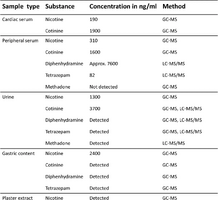
Various samples (cardiac serum, peripheral serum, urine, gastric contents and a plaster removed from a thigh) were subjected to toxicological examination. Analyses were performed either with GC-MS or LC-MS/MS. The screening included 700 licit and illicit drugs and metabolites, such as analgesics, sedatives, antidepressants and other psychoactive drugs. The results are indicated in Table 1.
The nicotine concentrations were in the toxic range in cardiac serum and especially in serum from a peripheral vein. Nicotine could also be detected in the gastric contents and in urine. High concentrations of its metabolite cotinine were determined in the serum samples and in urine. In addition, diphenhydramine could be identified in the body fluids. Its concentration measured in the serum from a femoral vein amounted to approx. 7600 ng/ml, so that toxic and potentially lethal effects have to be assumed.
The analyses also yielded a subtherapeutic serum concentration of tetrazepam. Methadone was determined in urine only. By HS-GC-FID, ethanol was detected in peripheral venous blood in a concentration of 0.14 g/kg and in urine (0.29 g/kg).
According to the autopsy findings and toxicological analyses, death was caused by a mixed intoxication with nicotine and diphenhydramine in the additional presence of a low concentration of tetrazepam. In conformity with the police investigations, the fatality was categorized as suicide.
Table 1: Toxicological Report:
A 51-year-old man was found dead in his apartment after he had not been seen alive for several days. The entrance door was locked, and the blinds were closed. The man was found lying on his bed in a supine position with a blanket covering the body up to the neck. After removal of the blanket, the police found two electric cables running across the abdomen. The cables were attached to each other and knotted to the bed frame. Neither of these cables was connected to an electrical outlet. A pair of handcuffs, one cuff covered with plush, was affixed to the right wrist and to the cables . The tying primarily suggested an autoerotic accident.
Once undressed, a large black plastic sheet was discovered on the abdomen, the edges of which were fixed to the skin with adhesive strips. The front sides of both thighs also showed several plasters (12 in total) of a dark brown color. Below the sheet on the abdominal skin, there were soaked compresses containing dark brown particles with a sweet tobacco smell. The same material was applied to the inner surface of the plasters on the thighs. A glass containing similar brownish material was found on a table next to the body.
Autopsy was performed four days after discovery of the body (weight 68 kg, height 169 cm). The external examination yielded resolved rigor mortis and minor signs of putrefaction. There were no injuries visible.
Autopsy did not reveal any pathology that could explain death. The inner organs showed only slight signs of putrefaction. The lungs were heavy and congested with blood. The bladder contained 350 ml urine. In the stomach, there were about 300 ml of black to dark brown liquid, mixed with small particles reminding of fine-cut tobacco and some small corny fragments. Moderate general arteriosclerosis was observed. No signs of trauma were noticeable.
Histological investigation confirmed moderate chronic emphysema in combination with blood congestion of the lungs and minor autolysis of the organs. Pulmonary sections were not only stained with hematoxylin-eosin and Berlin blue, but also with Fat Red 7B [29-30] in order to visualize so-called smokers cells (smokers macrophages). The substantial presence of predominantly intraalveolar macrophages containing brownish-reddish pigment inclusions corroborated the assumption that the deceased had been a heavy smoker. No siderophages could be detected in the pulmonary sections.
Various samples (cardiac serum, peripheral serum, urine, gastric contents and a plaster removed from a thigh) were subjected to toxicological examination. Analyses were performed either with GC-MS or LC-MS/MS. The screening included 700 licit and illicit drugs and metabolites, such as analgesics, sedatives, antidepressants and other psychoactive drugs. The results are indicated in Table 1.
The nicotine concentrations were in the toxic range in cardiac serum and especially in serum from a peripheral vein. Nicotine could also be detected in the gastric contents and in urine. High concentrations of its metabolite cotinine were determined in the serum samples and in urine. In addition, diphenhydramine could be identified in the body fluids. Its concentration measured in the serum from a femoral vein amounted to approx. 7600 ng/ml, so that toxic and potentially lethal effects have to be assumed.
The analyses also yielded a subtherapeutic serum concentration of tetrazepam. Methadone was determined in urine only. By HS-GC-FID, ethanol was detected in peripheral venous blood in a concentration of 0.14 g/kg and in urine (0.29 g/kg).
According to the autopsy findings and toxicological analyses, death was caused by a mixed intoxication with nicotine and diphenhydramine in the additional presence of a low concentration of tetrazepam. In conformity with the police investigations, the fatality was categorized as suicide.
Table 1: Toxicological Report:


